Khalel Dosmukhamedov and his legacy
Khalel Dosmukhamedov and his legacy
Khalel Dosmukhamedov is one of those who left a special mark on Kazakh pedagogy and education. Having defined the theoretical foundations of Russian pedagogy, Dosmukhamedov invested a lot of work in this area. The fact that his writings have not yet been studied is due to his independent political views, the ideas he affirms, and the road he once took.
Most of his works disappeared without a trace during the years of repression and persecution. The other part, extracted from dusty archives and book repositories, is only now being brought into the system, analyzed and processed by research scientists and is the basis for studying Dosmukhamedov's creative heritage, its place and role in the development of pedagogical science and education.
But not for a moment did he forget his duty as a doctor. He was very fond of children, and always treated them, even during the years of exile, he worked as a children's doctor at school. At the Institute, he was engaged in the education of children, organized the Department of Pedology, later receiving the title of Professor of Pedology. Putting the health of the people at the forefront, Dosmukhamedov, fulfilling his duty, worked hard and fruitfully in this field.
He worked at the Kazakh Institute of education, which was located in Tashkent at that time. The Institute was a solid cultural and educational center, and its role as a center of culture, it was difficult to overestimate. The years of work in Tashkent (1920-1929) were the most fruitful for Dosmukhamedov in creative terms, because it was during this period that most of his works were written and published. Here you can systematize your knowledge obtained at Saint Petersburg University, generalize and Supplement it with the experience of many years of work. Dosmukhamedov did a lot to leave a worthy legacy to future descendants in the field of science and education.
He was actively involved in the creation of a new national school system and the development of Kazakh terminology. Khalel Dosmukhamedov used his teaching experience in preparing textbooks for schools and, as their author, became widely known. Such works as "Inanimate nature", "Textbooks of Zoology" (1922), "Synharmonism in the Kazakh language" (1923), "Hygiene of school children" (1925) and the third part of the textbook of Zoology (1926) were published. These books rightfully occupy a special place in the history of Russian textbooks.
In addition to textbooks, he was actively engaged in translations. He translated and published books by Yu. Wagner's "Stories about how our body is arranged and works", "Stories about how plants live and work". Khalel Dosmukhamedov continued his fruitful teaching experience in 1929 at the newly opened Kazakh pedagogical Institute.
Being in the thick of cultural and educational events of the 20-30s of the XX century, which were particularly significant in the history of the spiritual life of the Kazakhs, Khalel Dosmukhamedov, sharing his observations, often said: "If we want to be cultured, we must choose the right road and get enough food to go on the road. Who does not fuss, and on the Arba will overtake a hare, it is necessary to leave slander, envy, gossip: that said so, and another this way. The Shearer should not compete with the Tulpar, he will not catch up with it. We must remember the saying: "Ayaz bi, know your strength; ant, don't stray from your path." Without too much noise and noise, you need to gain knowledge, purposefully go to the intended goal."
These words of an outstanding personality, such as Khalel Dosmukhamedov, can be called as if they were programmatic: to leave all the strife, United in the pursuit of a single goal - national culture.
Dosmukhamedov represented the most active part of the intelligentsia who participated in the social and political life of the Republic, and in this field gained great fame and popularity. Having proved the importance of national psychology in the formation of the younger generation, he makes a number of proposals for the reform of educational work. His achievements in the development of ethnopedagogics and ethnopsychology are undoubtedly of great interest to researchers. He first developed the scientific and theoretical foundations of national character features.
These views of his concerning the issues of ethnopedagogics and ethnopsychology are reflected in his works on folklore, because Dosmukhamedov saw the origins of national pedagogy and psychology primarily in folk art.
For example, in his writings, he wrote that many features of the national character are expressed in the art of aitys. And in this regard, oral folk art is a source of education, because it is a storehouse of spiritual treasures, a whole science of spirituality.
He said that the existence of an ethnic group, its further development is directly related to the language, especially the language proficiency of children. At the beginning of the XX century, Khalel Dosmukhamedov proposed to develop the language from below, linking it with the spiritual life of the people, seeing in this a manifestation of the eternal renewal of the native language, its immortality.
Kh. Dosmukhamedov, in addition to his main specialty - medicine, was well versed in the problems of anatomy, physiology, Zoology, botany. The scientist paid close attention to terminology, pointing out the special meaning of terms in science. In various of his works, there are many special words created by him.
We admire the current relevance of its provisions and conclusions in the field of ethnopedagogics and ethnopsychology about the place of the native language in the life of the nation. "If vodka, nicotine, and diseases destroy the body, then foreign words forcibly introduced into use destroy the language." "Language is the soul of the people". "A people who do not know the language cannot be called a people." "Knowledge is achieved through language." "A nation that has lost its language will lose itself." "The rich language of an educated people". "The language of a people striving for culture is enriched."
Bilingual website (Kazakh, English) dedicated to the life and work of Khalel Dosmukhamedov. - https://www.dosmukhameduly.kz/ .

KH. DOSMUKHAMEDOV - CITIZEN, ACTIVIST, SCIENTIST
Khalel Dosmukhamedov - Mashakov was born on April 24, 1883 on the bank of the river Zharypshykkan in the sands of Taisoigan Kyzylkogin district of Atyrau region (former Guryev).
Khalel's father Mashak (1850-1909), son of Baynak (1783-1885), came from the Tumash family of the Berish tribe, and his mother Aiken was a people of her time endowed with high spirituality.
Khalel began his education with a village mullah, then received his primary education at a one-class Russian-Kirghiz school in the town of Oyil (Kokzhar), and later, in 1903, graduated with honours from a real school in Orenburg. In the same year he entered the Imperial Military Medical Academy in St Petersburg, from which he graduated with honours on 17 November 1909, receiving the degree of Doctor of Medicine.
During his studies at the Academy, Khalel received scholarships of the State Counselor of Adiung and the Maritime Department.
From May 8 to August 31, 1909 he worked in the district zemstvo hospital of the Morchansky section of Cherdynsky uyezd, Perm province, combining two responsible positions, which corresponds to the modern industrial practice of graduates of higher educational institutions.
On 29 November 1909, by Order No. 51, he was appointed junior doctor to the 2nd Turkestan Rifle Battalion, where he served until April 1910.
From 18 April 1910 to 5 March 1913 he served as a military doctor in the 2nd Military Department of the Ural Cossack Troops in the fortresses of Ilbishin and Kalmykov, first as a junior and then as a senior doctor. He was then released from military service and transferred to civilian work.
From 1913 to 1919 he officially worked as a district doctor in Temir County.
During the First Russian Revolution (1905-1907), he participated in the Congress of Delegates of Five Regions in Orenburg, where he was elected a member of the Central Committee of the first political organisation in the history of Kazakhstan - "Kazakh Constitutional Democratic Party".
On 19 April 1917, at the regional congress of Kazakhs in Orenburg, he was elected chairman of the Ural Regional Kazakh (Kyrgyz) Committee.
From 21 to 28 July and from 5 to 13 December 1917 he took part in the National (All-Kirghiz) Congresses in Orenburg. At the last congress, the governmental body "Alash-Orda" was established, in which Khalel held the post of zemstvo head until the establishment of Soviet power.
In May-June 1918, together with Zhansha, Dosmukhameduly attended the reception of Lenin and Stalin, where he received permission to create an autonomy of Kazakhstan and was paid 12 million rubles.
In May 1918 he set up an autonomous government, the 'Provisional Government of Oyil'.
On 11 September 1918, the "Provisional Government of Oyil" was dissolved and replaced by the "Western Branch of Alash-Orda" under the leadership of Zhansh and Khalel Dosmukhamedov.
In early 1920, the Alash-Orda government officially ceased to exist, and Khalel was brought in to work for the Soviet government.
From 1920 he taught at the Institute of Public Education in Tashkent, while also working as a resident in the clinic of the Medical Faculty of the University of Central Asia.
In 1921 he became the chairman of the Scientific Commission of the Turkestan Republic, in 1922 a member of the board of the People's Commissariat of Health, and from 20 November 1924 the head of the Medical and Sanitary Department of the People's Commissariat of Health.
On 18 April 1924, he was appointed chairman of the Central Commission for Combating Epidemics.
In 1923, he was a member of the Talap Society and editor-in-chief of the journal Sana.
From 1925 he headed the Eastern Department of Kazgosizdat.
In 1926 he became deputy rector of the Kazakh Pedagogical Institute, and in 1927-1928 he headed the Commission for the Organisation of the Kazakh State University. Until 1 October 1929 he held the post of Vice-Rector of the University.
In 1924 he was elected corresponding member of the Central Bureau of Local History of the Academy of Sciences of the USSR, in 1927 he received the title of associate professor, in 1929 - professor.
He was actively involved in public work: he was a member of the Kazakhstan Society of Local History, a member of the scientific section of Rabpros, chairman of the terminology committee under the Kazakhstan government, etc.
As a result of Stalin's repressions, he was exiled to Voronezh on 14 September 1930.
After the period of exile (15 September 1935), he continued to work at the Voronezh Institute of Advanced Medical Education and headed the clinical and laboratory department of the city polyclinic.
However, at the height of Stalin's terror, he was arrested in Voronezh on 28 July 1938 and sentenced to death in Almaty on 23 April 1939.
Wife - Sagira Zhumagalieva
Children: Rabiga (1909), Әdilhan (Әlikhan) (1912), Saule (1913), Karashash, Tөle, Dәmetken (1928). They survived all the hardships of being "children of the enemy of the people", but thanks to their mother, Sagira, they received an education and became worthy members of society.
KHALEL DOSMUKHAMEDOV - SCIENTIST-DOCTOR
Khalel Dosmukhamedov selflessly fought the plague that swept southern Russia and western Kazakhstan.
He was instrumental in saving the Ilbisha, Temir and Taisoigan populations from mass extinction due to a plague epidemic.
Beginning in 1914, he published dozens of articles in the pages of the newspaper "Kazak", detailing the prevention of various diseases, their symptoms, methods of treatment and the medicines used.
His extensive article "Zhukpaly aurular" ("Infectious Diseases") was published in issues №60 and №602 of the newspaper "Kazak" for 1914.
On the basis of his work on plague control, he wrote the seminal work "How to Combat Plague among the Kazakh Population" (128 pages), which was published in Tashkent in 1924.
From 1920 Khalel worked as an assistant doctor at the hospital of the Medical Faculty of the Central Asian University in Tashkent.
In addition to teaching, he was Head of the Planning and Organisation Department of the Health Committee of the Kazakh ASSR.
In 1927 Kh. Dosmukhameduly received the title of associate professor in 1927 and professor in 1929.
In 1930 he was unjustly suppressed and sent into exile to Voronezh, where he taught at the Institute for Advanced Training of Doctors in the Department of Social Hygiene and Health Organisation until 1937.
KHALEL DOSMUHAMEDOV IS A HISTORIAN.
In 1923 in Tashkent, Khalel Dosmuhameduly wrote a scholarly commentary on the epic 'Kenesary-Nauryzbay' collected by Әbūbәkir Divayev and published it in a separate book. In this work he made a detailed analysis based on historical data.
He explained his aims as follows
- To prove the authenticity of the words of the poet Nysanbai, the author of the epic.
- To present the historical poem as a model for school education.
- To describe how the epic was handed down from generation to generation.
- To show an example of the publication of collected folk works.
He also commented on the names of historical figures, place names and obscure words, and gave a brief historical overview of Abylai Khan, Kasym Khan and Kenesary Kasymov.
Khalel Dosmuhamedov used in preparing the research:
- Shakarim's historical work,
- Akhmet tөre Kenesaryuly's work 'Kenesary and Sydyk tөre',
- Russian books about Turkestan and Zhetysu,
- Oral information from famous people of the time: Konyrkozha Kozhykuly, Mukhammetzhan Tynyshbayuly, Satarkul Dikanbayuly (grandson of Zhankarysh), Ishangali Aralbayuly, Әzimkhan Akhmetuly (grandson of Kenesary) and others.
He researched the largest popular uprisings of the XVIII-XIX centuries - Syrym Datuly, Isatay Taymanuly and Makhambet Utemisuly, Kenesary Kasymov. In his work "Brief Information on Isatay Taymanov's Movement" he gave a deep scientific analysis of the people's movements:
> The result of Isatai's rebellion was the relocation of 1869-1870. The fire Isatai lit smoldered for almost 40 years and then flared up again....
> But there was no unity among the rebels. There was no leader who could unite the entire Younger Juz. The rebel leaders - Alasha, Seyil, Baibakty, Berkin, Tabyn Aldash, Dauit, Shekti Yeset, Adai Isa - could not go beyond their own clan, could not take the rebellion to a wider level.
In this way, Khalel Dosmukhamedov scientifically substantiated the course and consequences of the century-long popular movement in the Younger Juz.
KHALEL IS A LITERARY SCHOLAR, FOLKLORIST, ETHNOGRAPHER
The scientist, who possessed outstanding research abilities, in his works "Sherniyaz sheshen" (1925), "Legend about the construction of madrasah Kөgiltash in Bukhara" (1927), The Chronicle of Batyr Zhalantus on the Construction of Madrasahs “Tillә-қari” and “Shirdar” in Samarkand (1926), compared folklore legends with historical and ethnographic data and paved his way in the study of the ancient history of our people.
The culmination of Khalel's work in the field of folklore is the essay "Literature of the Kazakh People" (1928). In this work he did an excellent job of classifying types of oral folk art. Khalel was one of the first scholars to consider folklore in unity with ethnographic data. The importance of this work is all the greater in our time, when national traditions and national consciousness are being revived.
The scientist published a rare example of oral folk art - 'aitys with spirits' - in the journal 'Sana' (1924, no. 2-3). He then went on to express his hypothesis on the origin and genesis of this oldest type of aitys, which was a valuable contribution to science.
KHALEL COLLECTED SAMPLES OF ORAL FOLK ART, ENRICHING OUR SPIRITUAL HERITAGE
On the basis of the materials he collected, Khalel prepared and published a preface and commentary to the books "Words of the Poet Murat" (1924), "Alaman" (1926), "Isatay-Makhambet" (1925). These three books are widely used in reprinting and researching the heritage of such poets as Makhambet, Murat, Ygylman, Kalniyaz and many others.
It is also to Khalel's merit that he was the first to honour the memory of the batyrs Isatay and Makhambet, who raised the spirit of the people and led them forward, by erecting a monument to them in words and making their names known to the entire Kazakh people. In 1924, his little article 'Kazakh Batyrs: Isatay and Makhambet' was published in the journal 'Saule' ('Kazakәdebyet - bilim kurasymy', No. 3, supplement to 'Akzhol', No. 416).
KHALEL IS THE FOUNDER OF THE SCIENCE OF MAHAMBET
In his small research work 'Makhambet batyr', he reveals the origin of the batyr and notes Makhambet was not only a batyr, but also a zhyrau and a dombrist. He also stresses: 'He was a man of a fiery character... Makhambet was able to ignite the people and carry them away with him.
Makhambet was an outstanding zhyrau, but much of his work has been lost. Khalel used 'words preserved among the people', recorded by the poet Murat.
Makhambet was an outstanding zhyrau, but much of his work has been lost. Khalel used 'words preserved among the people', recorded by the poet Murat.
In his studies 'Kazakh batyrs: Isatay-Makhambet' and 'Makhambet batyr', he has comprehensively highlighted the environment in which these two outstanding heroes grew up, their origins, the political and social environment of the time, the double oppression by the Tsarist government and Khan Zhangir. Khalel gave a detailed account of how they led an armed uprising for the freedom of their people and sacrificed their lives for this struggle.
In 1924, he published the book 'Words of the Poet Murat' in Tashkent. In the preface to the book he said: A person writing the history of the Kazakh people cannot ignore the words of such poets as Murat.
On the one hand, Murat was a chronicler who knew the past; on the other, he was a popular poet who expressed the sorrows and aspirations of his people. His work is invaluable for the history of literature,' he concluded.
In the book, he gave explanations to 248 names found in the dastans 'Yish kiyan' and 'Saryarka', and in the zhyrs 'Kaztugan', 'Shalkiiz', 'Atten bir kap duniye-ai' and 'Karasai-Qazi'. Among them, he explained 62 personal names and 186 geographical names, indicating their exact location. This testifies to Khalel's profound knowledge of toponymy.
Khalel played a great role in compiling the shezhire of the Kazakh people. He wrote that within the Younger Juz there are the tribes of Әlim, Bayuly and Zhetiru, which together are called Alshyn, and the people call themselves ‘Үsh Alshyn’.
The scholar listed in detail the 25 clans that inhabited the Younger Juz, indicating the areas of their settlement in Kazakhstan and quoting the battle cries (uran) of each clan.
HALEL – LINGUIST
Khalel Dosmukhamedov was the founder of Kazakh terminology, a linguist who left an indelible scientific legacy. He conducted research into the phonetics and orthography of the Kazakh language, literary language and the history of Turkic languages.
In 1924, the scientist published a book in Tashkent entitled 'The Law of Singharmonism in the Kazakh-Kirghiz Language'. In this work he wrote: 'Singharmonism, when we speak in Kazakh, means coherence, similarity'.
Syngarmonism is a special feature unique to the Turkic language..... Instead of the term 'harmony of vowels', we consider it more correct to use the term 'harmony of sounds'. There are no words or word changes in the Kazakh-Kyrgyz language that do not obey the law of syngarmonism,' he concluded.
Khalel is a scientist who has developed and implemented a scientific programme for the spiritual development of our people.
In 1923, the Talap Society was founded in Tashkent, the capital of the Turkestan Autonomous Republic. Khalel Dosmukhameduly was one of its six ordinary members. The Society was engaged in important and urgent tasks necessary for the people:
A) the study of the literary language of the Kazakh-Kyrgyz peoples, scientific terminology, orthography and other linguistic issues;
B) the study of architectural art;
C) the organisation and improvement of the educational system in Kazakh-Kyrgyz schools;
D) the support of writers and artists of the Kazakh-Kyrgyz peoples.
Khalel Dosmukhamedov not only contributed to solving the above-mentioned problems of 'promoting the cultural development of the Kazakh-Kirghiz people', but also bore the brunt of this work for seven years. In doing so, he illuminated his people with the light of cultural enlightenment.
KHALEL - SCIENTIST-EDUCATOR, ORGANISER OF KAZAKH SCHOOLS AND HIGHER EDUCATION INSTITUTIONS
From 1920 Khalel worked as a teacher at the People's Educational Institute in Tashkent.
In 1923 he became Chairman of the Scientific Council of the Turkestan Republic.
From the same year he headed the 'Kyrgyz-Kazakh Educational Commission'.
He was also one of the founders of the Talap Society, established to develop the culture of the Kazakh-Kyrgyz people.
Together with Kazakh figures such as T. Zhurgenov and S. Saduakasov. Khalel gave speeches and wrote articles arguing for the establishment of national higher education institutions.
In October 1929, the Kazakh State University (now KazNPU) was opened in Almaty on the basis of the Pedagogical Institute in Tashkent. Khalel took an active part in its organisation and was appointed first vice-rector.
In 1924 Khalel was elected a corresponding member of the Central Bureau of Local History of the Russian Academy.
He was promoted to associate professor in 1927 and professor in 1929.
At that time, when Kazakh schools were being opened en masse in different regions, he actively participated in the creation of a new educational system, the development of textbooks in the national language, and also had a great influence on the writing of textbooks on psychology, pedagogy and literature by such scientists as M. Zhumabaev, J. Aimauytov, M. Omarkhanov, Әuezov and others.
Khalel skilfully combined educational activities with the publication of textbooks in Kazakh, writing science textbooks in his native language.
In the 1920s, he made a significant contribution to the development of science and education in the Kazakh steppe, promoting the opening of boarding schools for nomads, the production of educational materials, teacher training and the development of various scientific fields.
KHALEL IS A SCIENTIST WHO WAS THE FIRST TO WRITE SCIENCE TEXTBOOKS IN HIS NATIVE LANGUAGE
The eminent scientist, who was working on the first science textbooks in his mother tongue, was aware of the responsibility of this task and wrote:
'Up to that time there was not a single book on science in Kazakh, except for Akhmet's 'Til-qural'. Since we had no model, it was extremely difficult to write a scientific book. The Kazakh language was not adapted to the scientific style, its terminology was not yet organised. Therefore, it was time to familiarise the Kazakh language with science and direct it in a scientific direction.
When translating scientific knowledge into our language, the most important thing is the correct and understandable translation of scientific terms. Giving correct and understandable scientific terms in Kazakh is a very difficult task. Although creating scientific terminology is difficult at first, it is a very necessary task.
In the first books, therefore, the development of appropriate scientific terms is more important than the pursuit of artistic expression and the slenderness of language.
This first extremely responsible, complex and labour-intensive work in the history of Kazakh science was carried out by Khalel Dosmukhamedov. It gave Kazakh readers the opportunity to study science in their mother tongue.
His book 'Zhanuarlar' ('Animals') was first published in Tashkent in 1922 with a print run of 35,000 copies. Later, in 1927, it was reprinted in Kyzylorda and Moscow.
His other works are:
- ‘Natural Science’ - 1922.
- ‘Preservation of pupils’ health’ - Tashkent, 1925.
- ‘Physiology of Man’ - Kyzylorda-Moscow, 1927.
- Kazakh-Russian dictionary of natural sciences
- ‘About bony fishes’ - 1928.
KHALEL IS A JOURNALIST, TRANSLATOR AND PUBLISHER
From 1913, Khalel took up the pen and began to participate in the work of the press. During this period he regularly wrote articles for the newspapers Oral, Pikir and Kazak.
Khalel wrote scientifically significant articles on language, public education, history, medicine and treatment in the pages of newspapers and magazines such as 'Sholpan', 'Akzhol', 'Yenbekshi kazak', 'Saule'. He founded the magazine Sana under the Kyrgyz-Kazakh Commission and became its editor.
In 1923 he headed the department of the State Scientific Publishing House of Turkestan.
Together with Professor Polivanov, Khalel prepared for printing and edited the book "Additional materials to the history of Sultan Kenesary" (1923), as well as collections of zhyrs "Kyz Zhibek" (1923) and "Kenesary-Nauryzbay" (1923).
In 1923, Khalel opened the journal "Sana" under the "Kazakh-Kyrgyz Commission" and became its editor. The magazine set itself the task of working in 52 directions in the field of public education, and most of them were successfully implemented.
He also worked on popular science translations, broadening the horizons of readers. Khalel translated books by Y. Vanger: 'Stories about how our body is organised and works' (Denelerimizdinң tүzelui men zhұmys қыluy, 1924) and 'Stories about the life and organisation of plants' (Өсімдімдіктердің тіршілігі мен түzelui туралы әңгімелер, 1924). He also wrote a book in Russian in 1918 and 1924 entitled 'How to fight the plague among the Kazakh population'.

Volume One. Mental Health
Kh. Dosmukhamedov
Year of publication: 2017
Number of pages: 432
Publisher: "Arys", Almaty
Information about the book:
Dosmukhameduly Kh. Work: The first volume. Health of the soul / Compiled by Professor G. Anes. - Almaty: Arys Publishing House, 2017. - 432 pages + 16 pages of illustrations.
For the first time a complete three-volume book of the works of the outstanding statesman and public figure, leader of the "Alash" movement, Professor Khalel Dosmukhamedula (1883-1939) is published. The first volume of his selected works includes works on Kazakh history and genealogy, literature and language. The book is intended for all those interested in Kazakh intellectual culture, especially students, postgraduates and young specialists.

Volume Three. Animals
Kh. Dosmukhamedov
Year of publication: 2017
Number of pages: 536
Publisher: "Arys", Almaty
Information about the book:
Dosmukhameduly Kh. Work: Third volume. Animals / Compiled by Professor G. Anes. - Almaty: Arys Publishing House, 2017. - 536 pages.
For the first time a complete three-volume book of the works of the outstanding statesman and public figure, leader of the “Alash” movement, Professor Khalel Dosmukhameduly (1883-1939) is published. The third volume of his selected works includes the textbook "Animals", published at the beginning of the XX century and reprinted three times in three books. The book is intended for all those interested in Kazakh spiritual culture, especially students, postgraduates and young specialists.
 Volume Three. Animals
Kh. Dosmukhamedov
Year of publication: 2017
Number of pages: 536
Publisher: "Arys", Almaty
Information about the book:
Dosmukhameduly Kh. Work: Third volume. Animals / Compiled by Professor G. Anes. - Almaty: Arys Publishing House, 2017. - 536 pages.
For the first time a complete three-volume book of the works of the outstanding statesman and public figure, leader of the 'Alash' movement, Professor Khalel Dosmukhameduly (1883-1939) is published. The third volume of his selected works includes the textbook "Animals", published at the beginning of the XX century and reprinted three times in three books. The book is intended for all those interested in Kazakh spiritual culture, especially students, postgraduates and young specialists.
 Alaman
Kh. Dosmukhamedov
Year of issue: 1991
Number of pages: 176
Publisher: Ana tili, Almaty
Information about the book:Dosmukhameduly Kh. Alaman (Compilers, authors of the foreword and comments - Garifolla Anes, Amankos Mektepov, Shamshadin Kerimov) - Almaty: Publishing house ‘Ana tili’, 1991. - 176 pages.
Outstanding scientist, doctor, historian and public figure Khalel Dosmukhameduly, who became a victim of Stalinist repressions of the 1930s, left valuable works on the history and theory of literature, as well as on language issues. He collected samples of Kazakh literature and compiled the chrestomathy ‘Alaman’. In this work, the author analyses the works of Makhambet Өtemisuly and Murat Monkeuly in a deep and scientifically sound manner. He also studied the laws of harmony of sounds in the Kazakh and Kyrgyz languages. These works, which have not lost their relevance, have become available to readers again after almost seventy years.
 Volume Three. Animals
Kh. Dosmukhamedov
Year of publication: 2017
Number of pages: 536
Publisher: "Arys", Almaty
Information about the book: Dosmukhameduly Kh. Work: Third volume. Animals / Compiled by Professor G. Anes. - Almaty: Arys Publishing House, 2017. - 536 pages. For the first time a complete three-volume book of the works of the outstanding statesman and public figure, leader of the 'Alash' movement, Professor Khalel Dosmukhameduly (1883-1939) is published. The third volume of his selected works includes the textbook "Animals", published at the beginning of the XX century and reprinted three times in three books. The book is intended for all those interested in Kazakh spiritual culture, especially students, postgraduates and young specialists.
 Khalel Hakim close to his people
Tolegen Zhanabayuly
Year of publication: 2018
Number of pages: 206
Book details:A great personality of the Kazakh people, one of the two leaders of the Western branch of the Alash Orda, a statesman and public figure, an outstanding scientist, Professor Khalel Dosmukhamedov is a figure about whom one can talk endlessly. Tolegen Zhanabayuly, writer, local historian, honorary journalist of Kazakhstan, laureate of the prize of the Union of Journalists of Kazakhstan, honorary citizen of Kyzylkogin district, in his publicistic narrative tells little-known facts about the life of the scientist, his homeland, family and environment. The book also describes important moments related to the return of Khalel Dosmukhamedov's name to the nation, including both joyful and difficult episodes. The publication is intended for a wide readership, teachers and students of educational institutions.
https://drive.google.com/file/d/1G46I-qrmlTCk1Q1z2FGacfB9mrhPWBID/view?usp=sharing

Оқушының саулығын сақтау.
Сохранение здоровья учащихся.
Maintaining the health of students.
Anarbek Regina
Year of publication: 2023
Number of pages: 20
About the book:The book of the great scientist, public figure, educator and naturalist Khalel Dosmukhameduly "Okushynynynң saulyғyn saqtau" was translated into three languages (Kazakh, Russian, English) and is intended for all students.
https://drive.google.com/file/d/1DoA1z1KdWXpC-dCaJspRa1lvkWAQNm9v/view?usp=sharing
Selected works
Alaman
Enlightener Khalel
Alaman
Animals
Khalel is the ruler of the people
Physical health
A person with a high pedestal
Mental health
Khalel Dosmukhameduly selected works
On 23 May 1994, by the decision of the Cabinet of Ministers, the Atyrau Pedagogical Institute was given the name of an outstanding scientist, Professor Khalel Dosmukhamedov. The return of the name of the great scientist Khalel Dosmukhamedov has opened up opportunities for the study of his diverse and inexhaustible scientific heritage, as well as for the in-depth study of his pedagogical heritage.
For the purpose of further improvement of higher education, development of the system of training of specialists and scientific and pedagogical personnel in the region, the Cabinet of Ministers of the Republic of Kazakhstan by its decision of 2 June 1994 transformed the Atyrau Pedagogical Institute named after Khalel Dosmukhamedov into the Atyrau University named after Khalel Dosmukhamedov.
It included:
- Atyrau Branch of the Kazakh National Technical University, renamed Khalel Dosmukhamedov Institute of Oil and Gas at Atyrau University; - Aktau Branch of the Khalel Dosmukhamedov Atyrau Pedagogical Institute; - Atyrau Pedagogical College; - Atyrau Polytechnic College; - Regional Institute for Teacher Training.
The scientific legacy of the outstanding scientist has been included in the research plans of the teachers of some departments of Atyrau University named after Khalel Dosmukhamedov.
Since 2003, in accordance with the decision of the Academic Council of the University, the course "Halelology" has been included in the curricula of all faculties of the University. In the same year, under the editorship of Professor K.B. Seitaliev, Doctor of Pedagogical Sciences, and Associate Professor G. Bazargaliev, Candidate of Pedagogical Sciences, the course programme and textbook "Halelology" in the volume of 15 p.l. were published.
In addition, a Halel Studies research centre has started work at the university from November 2024.


Solemn ceremony of laying flowers at the bust of
H. Dosmukhamedov and honouring his memory.
Dosmukhamedov and honouring his memory
Scientific Research Centre “Khalelology”

General information
Scientific Research Centre "Khalelology" is a structural subdivision of Kh. Dosmukhamedov Atyrau University. In its activities the Centre is guided by the laws of the Republic of Kazakhstan, regulatory legal acts, orders of the Ministry of Science and Higher Education of the Republic of Kazakhstan, the Charter of Kh. Dosmukhamedov Atyrau University and this Regulation.
Full name of the centre: Halelology Research Centre.
The Centre is organised as a scientific and production research association of Kh. Dosmukhamedov Atyrau University.
Main objective
Research and study of scientific heritage of encyclopaedist scientist, Professor Kh. Dosmukhamedov and introduction of his works into scientific turnover in the field of history of pedagogy.
Main objectives
3.1 Research and study of Kh. Dosmukhamedov's creative heritage at the intersection of pedagogy, natural sciences, linguistics, history and philology, as well as digitalisation of his scientific heritage according to modern requirements.
3.2 Exploration of the application of Khalel Dosmuhamedov's heritage abroad.
3.3 Familiarisation and popularisation of the life and work of the scientist among students on academic mobility programmes and foreign teachers.
3.4 Education of youth in the spirit of patriotism, national consciousness and citizenship on the basis of the ideas contained in the pedagogical heritage of the scientist.
3.5 To carry out other activities not prohibited by the legislation of the Republic of Kazakhstan.
Main functions
4.1 Organisation and performance of scientific and research work, participation in international, state, branch and regional scientific projects and programmes.
4.2 Carrying out other research works on the basis of permission (licence) from authorised bodies of the Republic of Kazakhstan.
4.3 To conduct basic and applied scientific research in priority areas of science and technology.
In addition, the Centre provides the scientific community, researchers, master students with scientific articles of Khaleltanovets, as well as a collection of documents from the Central State Archive of the Republic of Uzbekistan (about 250 documents), 164 archival documents from the State Archive of the Republic of Kazakhstan, as well as copies of rare books from the fund of the National Academy of Sciences, published in 1922-1926.
Applied research funded from the intramural budget:
Ways of effective use of Kh. Dosmukhamedov's heritage in the educational process of students" - Head: Dzhanzakova Sh.I., Doctor of Pedagogical Sciences, Professor.
- Chief researcher: Bazargaliev G.B., Candidate of Pedagogical Sciences, Acting Associate Professor
Kh. Dosmukhamedov: Eminent Scholar, Educator, and Enlightener
One of the regions that has played a significant role in the history of our people and has contributed substantially to the spiritual growth and development of our nation is the modern-day Atyrau Region. Since ancient times, when local communities began to establish their foundations amid turbulent eras, the vast northern steppes of Atyrau have continued to attract the attention of researchers. Countless heroes, poets, eloquent speakers, and wise judges have emerged from this region over the centuries, leaving a lasting imprint on the social life of the Kazakh steppe. The distinguished figures of Atyrau left a significant mark on the history of the Kazakh people.
In this overview, we do not aim to provide a detailed account of every historical period of the Atyrau region. Our purpose is to reconnect the public with both the overlooked and the lesser-known truths of our national history. For many years, the names of great figures who were repressed or persecuted under Soviet ideology have been excluded from historical memory. Restoring their recognition is a civic duty of the younger generation. At the beginning of the 20th century, the region also produced prominent representatives of educational and national liberation movements, whose contributions shaped the future of the Kazakh people.
One such remarkable figure - indeed, a unique personality - is Kh. Dosmukhamedov, the subject of this report. His significant contributions to the Kazakh people and the future of his homeland, Kazakhstan, remain worthy of acknowledgment today.
In the early 20th century, Kh. Dosmukhamedov stood at the center of political life in Kazakh society, where his leadership and dedication elevated him to a prominent position. During his relatively short life, he demonstrated exceptional talent, remarkable ability, and tireless diligence.
A naturally gifted individual, Kh. Dosmukhamedov grew up in an environment rich in cultural and intellectual traditions - his native village imbued with the wisdom of elders and the guidance of local leaders. He mastered multiple languages in addition to his mother tongue, Kazakh, including Latin, Arabic, Persian, Turkish, Russian, German, and French. His polyglot abilities allowed him to fully reveal his multifaceted genius. Sensitive to the nuances of language, he was a linguist, folklorist, historian-ethnographer, and translator.
Thanks to his broad knowledge, he authored numerous significant works in biology, zoology, and medicine. Even today, his contributions to the development of biological sciences in Kazakhstan, as well as his linguistic scholarship, continue to be studied and appreciated.
Another important aspect of his legacy, which has drawn the attention of historians and the public, is his political work and service as a public figure in the national liberation movement. Modern generations primarily recognize and value Kh. Dosmukhamedov for these contributions. At the beginning of the 20th century, political leaders like him played a critical role in shaping democratic thought in Kazakh society, elevating the ideas of national independence to the level of a national ideal, and putting them into practice. Among the Kazakh intellectuals whose names shine in history, Kh. Dosmukhamedov holds a distinguished place as a leader of the Alash movement.
The intellectual elite of Kazakhstan, striving for equality and independence, carried forward the Alash legacy despite the coercive measures of Soviet power, seeking to serve their people as best they could. These intellectuals often set aside political ambition and devoted themselves to educational and cultural enlightenment, guiding their people from darkness into light through knowledge and moral leadership.
After the dissolution of the Alash government, forward-thinking Kazakh intellectuals actively participated in cultural and educational initiatives under the Soviet regime. In the fall of 1920, Kh. Dosmukhamedov began teaching at the Kazakh People’s Education Institute, while also serving as a hospital physician at the Medical Faculty of the Central Asian University.
In 1923, he was elected chairman of the Scientific Council of the Turkestan Republic and simultaneously took on responsibilities at the state scientific publishing house. At that time, the Turkestan Autonomous Republic included significant portions of Kazakhstan. In Tashkent, Kazakh intellectuals worked collaboratively despite the political distrust of the new government, dedicating themselves to the advancement of their nation. Kh. Dosmukhamedov’s scholarly, teaching, and leadership abilities shone in this environment, demonstrating the enduring resilience and contribution of Kazakh intellectuals during the difficult years from 1920 to 1937.
Despite constant threats, surveillance, and repression, these figures significantly contributed to the spiritual and cultural development of their people, serving as true guardians of the Kazakh nation. Even when unable to establish an independent state, they strove to preserve the national identity and spirit of their people under Soviet rule.
Intellectuals devoted to the prosperity of their nation aimed to elevate education and enlightenment among the people, thereby nurturing public consciousness and preserving national identity. They understood the underlying motives of the Soviet government’s far-reaching and covert policies. These courageous individuals, using their knowledge and skills, worked quietly to ensure the survival of their nation as an ethnic community. They collected, studied, and systematized the Kazakh language, customs, literature, culture, and history, transforming national heritage into a source of spiritual wealth.
In this endeavor, monumental works emerged: M. Tynyshbayev and S. Asfendiyarov in history, J. Aymauytov in psychology, A. Baitursynov in linguistics, and M. Zhumabayev in pedagogy. These efforts represented extraordinary struggles by Kazakh intellectuals to safeguard the nation’s spiritual independence. Kh. Dosmukhamedov also made significant contributions during these years in history, literature, and pedagogy.
One of the most prominent figures in Kazakh pedagogy and enlightenment, Kh. Dosmukhamedov scientifically founded and systematized national pedagogy. The delayed scholarly study of his work is largely due to his political activism, ideas, and path, as he was labeled a “public enemy” by the authorities. Many of his works were lost during periods of repression, making it difficult to fully study, preserve, and analyze his vast intellectual legacy even after his rehabilitation.
The surviving works, however, form the foundation for understanding his scholarly contributions. His role in education and pedagogy was exceptional. Regardless of his duties, he never neglected his responsibilities as a physician, often serving as a school doctor even while in exile. While teaching, he established the Department of Pedagogy and later earned the title of “Professor of Pedagogy.” Kh. Dosmukhamedov prioritized the health and well-being of his people, and his professional work became a vital service to society.
He worked at the Kazakh People’s Education Institute in Tashkent, a key institution that trained specialists for schools, extracurricular educational institutions, and cultural organizations. Intellectuals devoted to national revival and cultural development established enlightenment organizations to implement their vision. In Tashkent, the educated elite formed the “Talap” society to bring the light of culture to their nation. Kh. Dosmukhamedov served as chairman, with members including Professor Alexander Schmidt, Isa Toktabayev, Myrzagazy Yesbolov, Mukhametzhan Tynyshbayev, Mukhtar Auezov, and Kasym Tynystanov. Active participants included Magzhan Zhumabayev, Abubakir Divaev, Nikolay Arkhangelsky, Turar Ryskulov, and Sultanbek Kozhanov. The society produced dozens of books and educational materials.
Kh. Dosmukhamedov’s remarkable contributions to education were officially recognized: he was awarded the title of associate professor in 1927 and professor in 1929. In 1924, he became the first corresponding member of the Russian Academy of Sciences’ Local Lore Bureau. He also led the Planning and Organization Department of the Health Commissariat and edited the journal Sana, established by the Kazakh-Kyrgyz Education Commission in Tashkent.
Through his work in public education, Kh. Dosmukhamedov demonstrated himself as a devoted and compassionate servant of his people. He believed that culture was essential to national development and that knowledge required sustained effort and patience. His philosophy emphasized that to become a proud and independent nation, a people must first embrace education and culture. During the 1920s and 1930s, Kh. Dosmukhamedov combined profound wisdom with high-quality European education to lead transformative cultural and educational initiatives.
He made substantial contributions to ethnopedagogy and ethnopsychology, scientifically grounding the study of Kazakh national character for the first time. His findings on national pedagogy and psychology were often reflected in his folkloric works. For instance, various forms of Kazakh aytıs (improvised oral poetry competitions) illustrate multiple facets of human psychology - thought, speech, imagination, emotion, will, and character.
Kh. Dosmukhamedov viewed Kazakh oral literature as a primary source of moral and educational guidance. He emphasized that every genre of Kazakh literature carries pedagogical meaning, reflecting the lifestyle and psychology of the nomadic people. From birth to adulthood, children’s experiences were embedded in songs, poems, rituals, and folk traditions. Kh. Dosmukhamedov particularly highlighted the importance of lullabies, ceremonies, greetings, blessings, proverbs, riddles, wedding songs, heroic epics, and folk medicine songs in shaping children’s development.
He meticulously analyzed folklore to derive insights into child psychology, education, and the formation of national consciousness. He emphasized the crucial role of language, music, and traditional instruments, such as the dombra, in cultivating Kazakh identity. Kh. Dosmukhamedov recognized that children first hear and internalize the world through cultural sounds -most notably, the melody of a mother’s lullaby. His research connected ethnopedagogy, ethnopsychology, and scientific pedagogy to the development of a child’s language, character, and cultural awareness.
As a literary scholar, Kh. Dosmukhamedov authored significant works, including Kazakh Folk Literature and Its Content, written in Russian to present Kazakh cultural heritage to a wider audience. He later published Alaman, Isatay-Makhambet, and other critical studies, establishing foundational research in Kazakh literary scholarship. His studies systematically analyzed genres, content, and the moral significance of literary works, bridging literature, history, and social sciences.
Although a physician by training, Kh. Dosmukhamedov’s interdisciplinary expertise spanned pedagogy, linguistics, literature, psychology, and folklore, making him a truly universal scholar. His research in Kazakh language, including theory, grammar, and textbook development, significantly advanced the scientific understanding of national education. His insights into terminology, style, and language remain influential today.
Despite the challenges of his era, Kh. Dosmukhamedov pursued knowledge relentlessly. Today, on the 135th anniversary of his birth, Atyrau State University - bearing his name - stands as one of Kazakhstan’s leading higher education institutions. It is a source of pride that Kh. Dosmukhamedov’s legacy continues to inspire scholarship and education not only in Kazakhstan but around the world.
References
- Dosmukhamedov, K. Selected Works (Tandamaly) – Almaty: Ana Tili, 1998.
- Korkytov, B. Atyrau Biys and Heroes – Almaty: Olke, 1992.
- Dosmukhamedov, K. Alaman – Almaty: Ana Tili, 1991.
- Syzdykov, K., Kerimov, Sh. Alkalasa Aleumet. Poetry Collection – Almaty, 1991.
- Ozganbay, O. The State Duma of Russia and Kazakhstan (1905–1917) – Almaty, 1999.
- Nurpeisov, K.N. Alash and Alashorda – Almaty, 1995.
- Koigeldiev, M.K. Public and Political Activities of the Kazakh Democratic Intelligentsia in 1905–1917. Abstract of Doctoral Dissertation – Almaty, 1994.
- Koigeldiev, M.K. Public and Political Activities of the Kazakh Democratic Intelligentsia in 1905–1917 – Almaty, 1997.
- Koigeldiev, M.K. The Alash Movement – Almaty, 1995.
- Tynyshpaev, M. History of the Kazakh People. Preface and editors: A.S. Takenov, B. Baigaliev – Almaty: Kazakh University, 1993.
- Ozganay, O. The State Duma of Russia and Kazakhstan (1905–1917) – Almaty, 1999.
- Nurpeisov, K., Kulkenov, M., Khabizhanov, B., Meklepeov, A. Kh. Dosmukhamedov and His Life and Works – Almaty: Sanat, 1996.
- Tabyldiev, Kh.B. “His Name Lives in People’s Memory” – Densaulyk, 1995, No. 7.
- Dosmukhamedov, K. “On Infectious Diseases” – Kazakh Newspaper, 1914, Nos. 60, 62.
- Editorial Board of the Kazakhstan National Encyclopedia – Almaty, 1998.
- Kazakh Newspaper, 1917.
- Nurpeisov, K. Political Views of Kh. Dosmukhamedov and His Life and Works – Almaty: Sanat, 1996.
- Alash Orda. Collection of Documents – Almaty, 1992.
- Amanzholova, D.A. Kazakh Autonomism and Russia: History of the Alash Movement – Moscow: Rossiya Molodaya, 1994.
- Dosmukhamedov, K. Natural Science, Part I – Tashkent, 1922.
- Dosmukhamedov, K. Animals, Part I – Kyzylorda, 1928.
- Dosmukhamedov, K. Human Physiology – Kyzylorda, 1927.
- Dosmukhamedov, K. Preserve Your Health – Almaty: Balausa, 1997.
- Pride of Alty Alash: Proceedings of the Republican “Kh. Dosmukhamedov Readings” Scientific-Practical Conference – Atyrau, 2000.
- Khabizhanov, B. Medical Service and Combating Infectious Diseases in the Country – In: Kh. Dosmukhamedov and His Life and Works – Almaty: Sanat, 1996.
- Dosmukhamedov, K. The Law of Sygarmonism in Kazakh-Kyrgyz Language – Tashkent, 1924.
- Seytaliyev, K.B. “Universal Scholar-Pedagogue” – Kazakhstan School, 1994, No. 6.
- Seytaliyev, K.B. Development of Higher Pedagogical Education in Kazakhstan – Almaty: Republican Publishing Cabinet, 1996.
- Koyanbayev, Zh.B., Koyanbayev, R.K. Pedagogy – Astana, 1998.
- Aubakirov, S. Ecology – Almaty, 1995.
- Kosherbayev, K. Kazakh Language and Literature – the Pillar of National Culture – Kazakh Language and Literature, 2000, No. 7.
- Syzdykov, K., Kerimov, Sh. Alkalasa Aleumet. Poetry Collection – Almaty, 1991.
- Sharip, Amantai. “Abai and the Nation” – Kazakh Literature, 2000.
- Auezov, M.O. History of Literature – Almaty, 1991.
- Dosmukhamedov, K. Isatay-Makhambet – Almaty: Olke, 1991.
- Bulletin of Kh. Dosmukhamedov Atyrau State University. Scientific Journal.
- Kozhakhmetova, K. National Education System in Schools: Theory and Practice – Almaty: RBK, 1997.
- Kaliev, S., Zharikbayev, K. Kazakh Pedagogy – Almaty, 1995.
- Sembayev, A.I. History of Kazakh Soviet Literature – Almaty, 1967.
- Kunantaeva, K. History of Education in Kazakhstan – Almaty, 1917–1990.
- III Republican “Dosmukhamedov Readings” – Atyrau, 2003.
- Atyrau State University: Present and Future – Almaty, 2001.
- Kh. Dosmukhamedov: Life and Works – Almaty: Sana, 1996.
- Dosmukhamedov, K. Selected Works (Tandamaly) – Almaty: Ana Tili, 1998.
- OROMA. Fund R-372, Inventory 1, File 15, pp. 51–73.
- OROMA. Fund 17, Inventory 1, File 293, p. 25.
- Nurpeisov, K., Kulkenov, M., Khabizhanov, B., Meklepeov, A. Kh. Dosmukhamedov and His Life and Works – Almaty: Sanat, 1996, p. 115.
- OROMA. Fund R-34, Inventory 1, File 293, p. 25.
- Nurpeisov, K., Kulkenov, M., Khabizhanov, B., Meklepeov, A. Kh. Dosmukhamedov and His Life and Works – Almaty: Sanat, 1996, p. 133.
- OROMA. Fund R-34, Inventory 1, File 2114, p. 13.
- OROMA. Fund R-34, Inventory 1, File 2114, p. 13.
- OROMA. Fund R-34, Inventory 1, File 2114, p. 13.
- Sana, 1923, No. 1.
- Pride of Alty Alash: Republican Readings – Atyrau, 2000, p. 60.
- OROMA. Fund R-34, Inventory 1, File 2114, p. 36.
- Dosmukhamedov, K. Natural Science, Part I – Tashkent, 1922, pp. 6–11.
- Dosmukhamedov, K. Animals, Part I – Kyzylorda, 1928, p. 229.
- Dosmukhamedov, K. Animals, Part I – Kyzylorda, 1928, p. 3.
- Dosmukhamedov, K. Animals, Part I – Kyzylorda, 1928, pp. 3–229.
- Dosmukhamedov, K. Human Physiology – Kyzylorda, 1927, p. 4.
- Dosmukhamedov, K. Human Physiology – Kyzylorda, 1927, p. 308.
- Dosmukhamedov, K. Volume I: Mental Health / Comp. Prof. G. Anes – Almaty: Arys, 2017, 432 p.
- Dosmukhamedov, K. Volume II: Physical Health / Comp. Prof. G. Anes – Almaty: Arys, 2017, 496 p.
- Dosmukhamedov, K. Volume III: Animals / Comp. Prof. G. Anes – Almaty: Arys, 2017, 536 p.
- Muratova, A. The Role of Kh. Dosmukhamedov in the Development of Kazakh Science and Language – Kazakh Language and Literature, 2000, No. 4, pp. 52–53.
- Dosmukhamedov, K. Preserve Your Health – Almaty: Balausa, 1994, p. 4.
- Dosmukhamedov, K. Preserve Your Health – Almaty: Balausa, 1994, p. 69.
- Pride of Alty Alash: Republican “Kh. Dosmukhamedov Readings” Scientific-Practical Conference Proceedings – Atyrau, 2000, p. 61.
- Pride of Alty Alash: Republican “Kh. Dosmukhamedov Readings” Scientific-Practical Conference Proceedings – Atyrau, 2000, p. 69.
- Dosmukhamedov, K. Selected Works (Tandamaly) – Almaty: Ana Tili, 1998, p. 349.
- KROMA. Fund 693, File 47, pp. 123–124.
- Alimkhanova, R. “The ‘Talap’ Society Led by Kh. Dosmukhamedov” – Akykat, 1998, No. 3, pp. 62–64.
- Educator Kh. Dosmukhamedov. Collection / Comp. G. Kabdolkaïrov – Almaty: Arys, 2004, 272 p.
.jpg)
.jpg)
.jpg)
.jpg "Рисунок: /upload/iblock/767/Скан_20200413 (5).jpg")
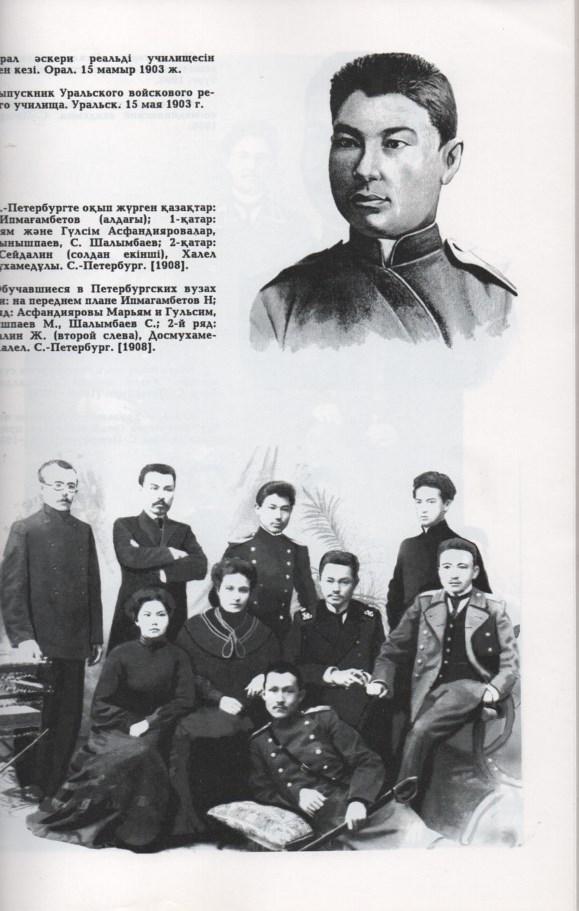
.jpg "Рисунок: /upload/iblock/767/Скан_20200414 (2).jpg")
.jpg)
.jpg)
.jpg)
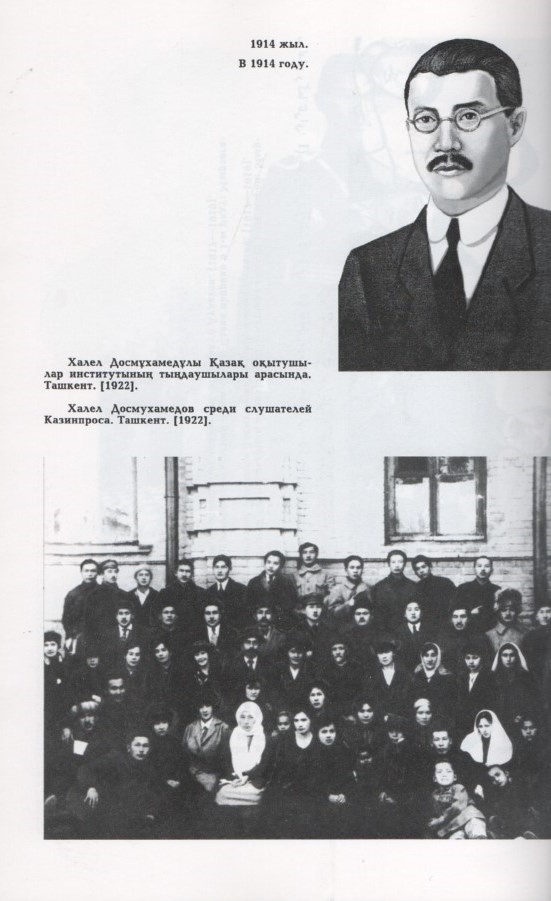
Университет профессорлары Аққали Ахмет пен Сайфулла Сапановтың 2019 жылғы Ресейдің Мәскеу және Воронеж қаласына жасаған ғылыми іс-сапары барысында әкелген құжаттарынан
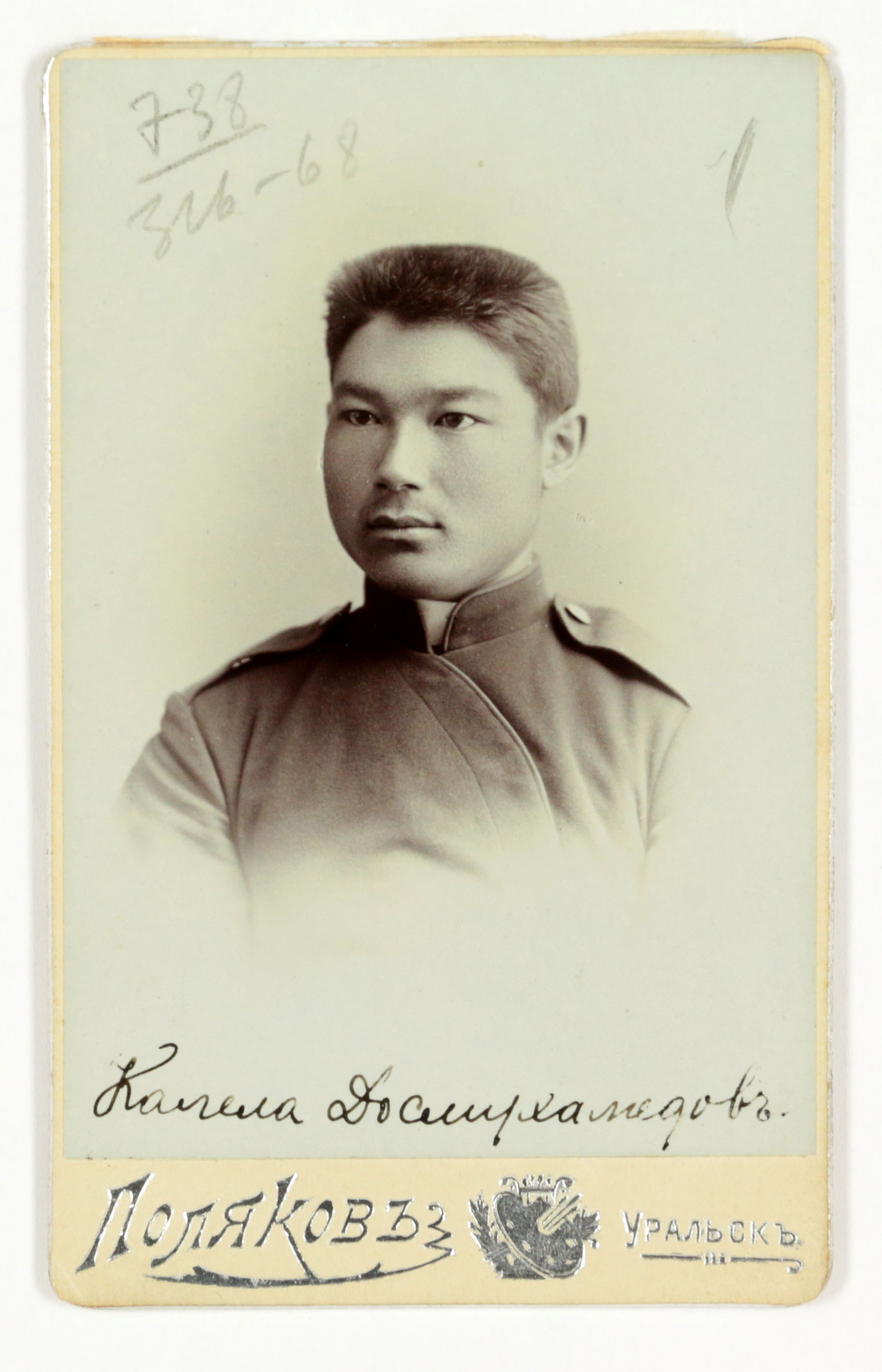
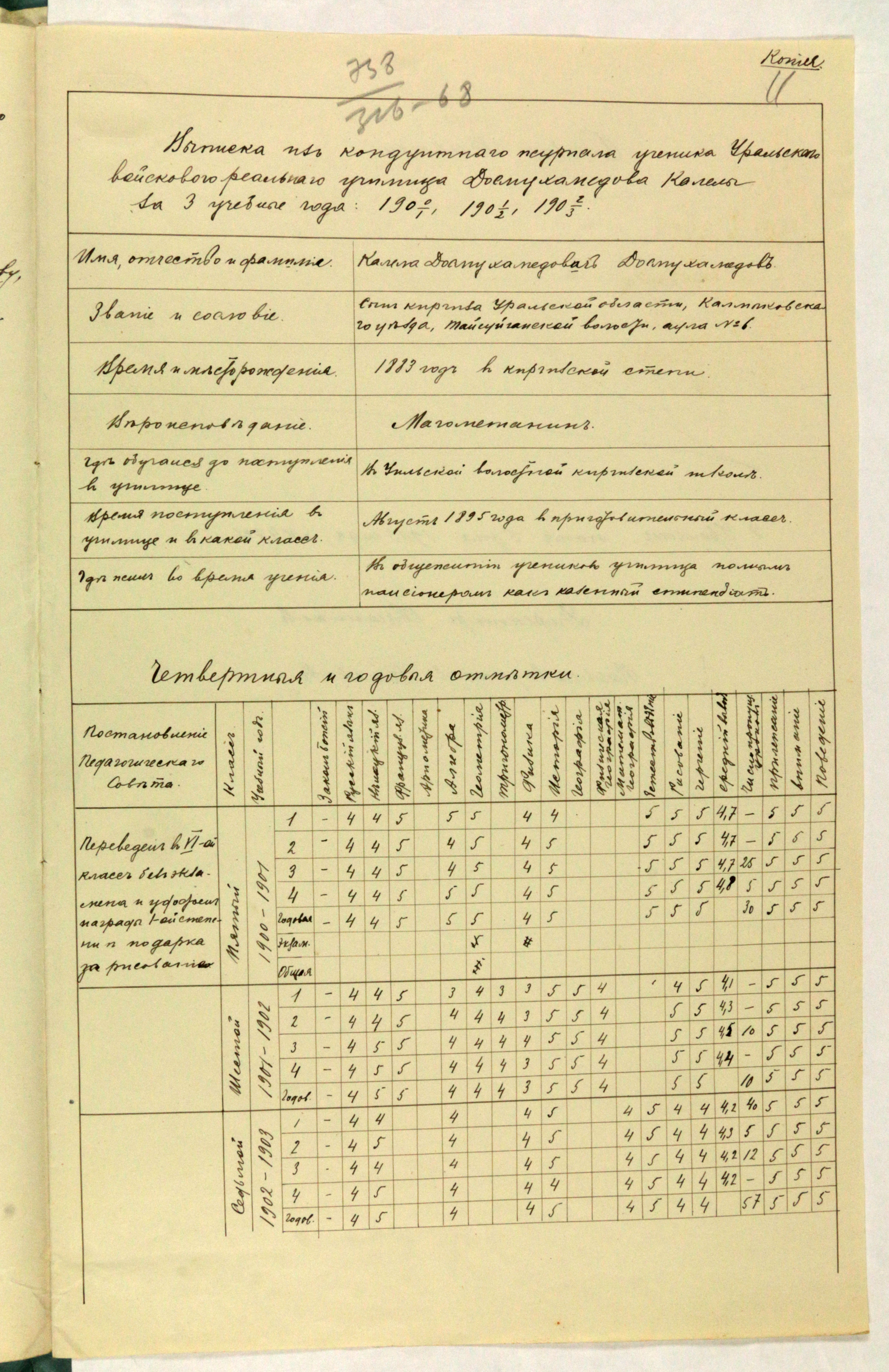
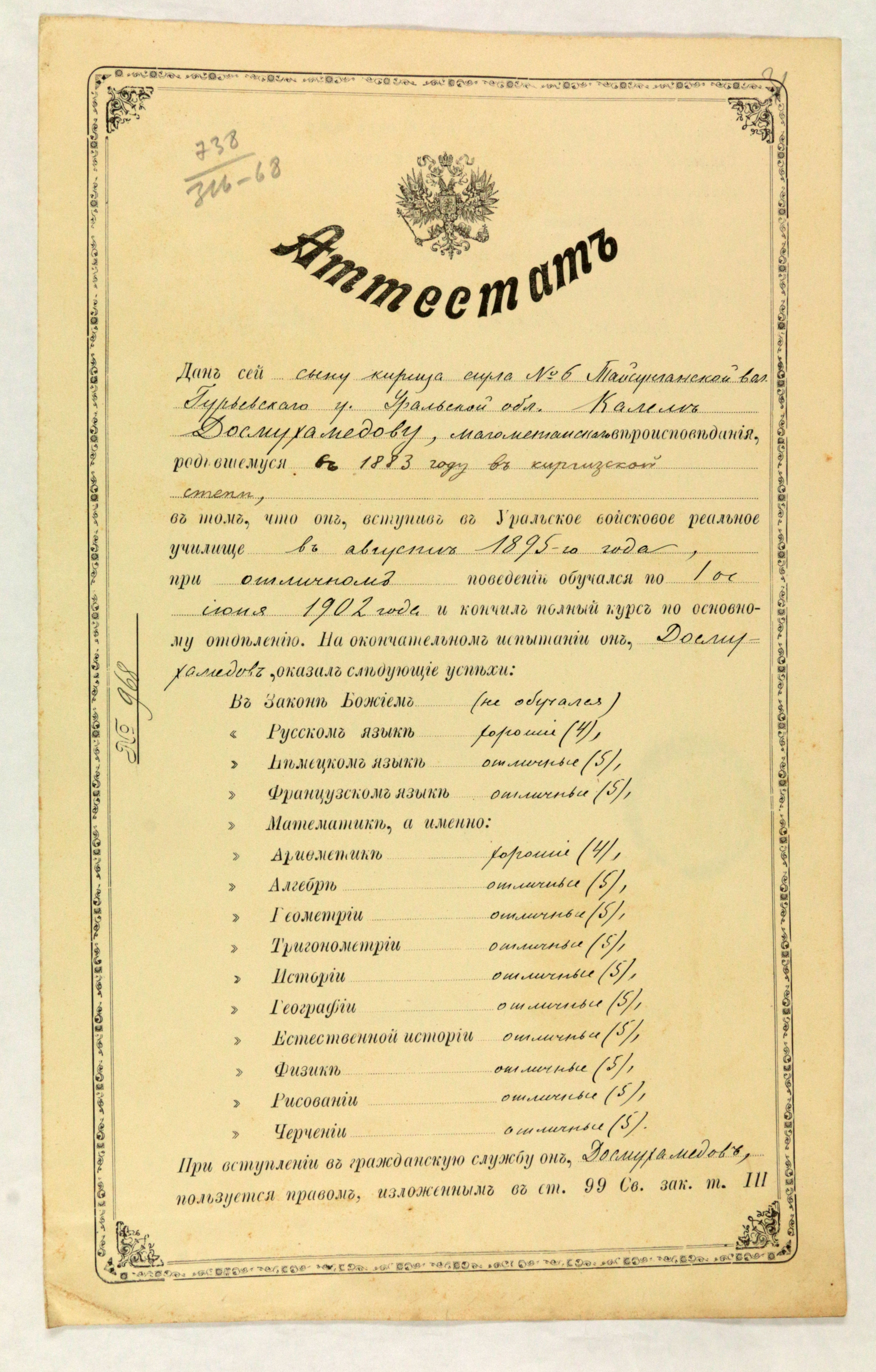

.jpg "Рисунок: /upload/iblock/767/Ф.Р-1714. Оп.2. Д.316.Л.1. (1).jpg")
автор: Базарғалиев Ғабит Бағытжанұлы


The house in Voronezh where Khalel lived


Khalel's personal ex-libris (bookmark)

Khalel's bet.

Resolution on awarding the name of Khalel Dosmukhamedov to the Kh. Dosmukhamedov Atyrau University

Khalel Dosmukhamedov is a doctor in the pioneer camp of School No. 7 in the city of Voronezh.
Collection of activities and published articles within the framework of perpetuating the legacy of Khalel Dosmukhamedov
International Conference "Theory and Practice of Formation of National Scientific Language
26 April 2024 Associate Professor of the Department of Psychology and Pedagogy of Atyrau University, Candidate of Pedagogical Sciences Bazargaliev Gabit Bakytzhanovich took part in the plenary session of the International Scientific-Theoretical Conference "Theory and Practice of Formation of National Scientific Language", organised by the Kazakh National University named after Al-Farabi in honour of the 100th anniversary of the First Congress of Kazakh Scientists. Within the framework of the conference, he presented a report on 'Khalel Dosmukhamedov and the formation of higher education in Kazakhstan'.


Dosmukhamedov Readings-2024
o The international scientific-practical conference "K.I. Satpayev and science in Kazakhstan" dedicated to the 125th anniversary of the academician of the Academy of Sciences of the Kazakh SSR Kanysh Imantaevich Satpayev was held in Atyrau University named after Khalel Dosmukhamedov within the framework of "Dosmukhamedov Readings-2024". Based on the results of the conference, a collection of scientific papers was published.


Round table "Khalel Dosmukhamedov - the mirror of Alash"
o On 10 October 2024, in honour of the 30th anniversary of the naming of Khalel Dosmukhameduly to Atyrau University, a round table "Khalel Dosmukhameduly - the mirror of Alash" was held. The event was attended by university professors who shared important historical and scientific data. The round table was held at a high level and was useful for all participants.
https://www.instagram.com/p/DA-1Vl-N9hB/?igsh=cHNtZjg4aHczbjM2


-
- Science project competition
- From 14 to 15 May 2024 the methodical centre of education of Kyzylkogin district organised a competition of scientific projects among graduates of 11th grades on the theme “Khalel and its heritage”. Gabit Bazargaliev, Associate Professor of the Department of Psychology and Pedagogy, Candidate of Pedagogical Sciences, acted as a jury member of the competition
- o According to the results of the competition:
- o - I place was awarded to Bagytzhan Aynelya (Zhanasharua Kazakh secondary school) with the theme “Khalel the linguist”;
- o - II place was awarded to Nurniyaz Aibar (secondary school named after G. Slanov) with the theme “Scientist of the century - Khalel Dosmukhamedov”;
- o - III place went to Alexandra Fatima (secondary school named after B. Amanshin) with the theme “Kh. Dosmukhamedov - researcher of Murat's poetry”.

The April and June issues of the university newspaper featured articles “Scholar of the Century” and “A University Named after Khalel”.
https://asu.edu.kz/ru/media/newspaper/19152/


If you think about the hundreds, thousands of Kazakhs receiving higher education, you will realise: this nation is also capable of working and moving forward. This means that one day it will take one of the honoured places in the world and become the second Japan.

It takes a lot of hard work and a lot of patience to get an education. There are many paths to knowledge. The most important are a good school and an educated teacher. In addition, you need books that are written in a language that everyone can understand.
Our time is the age of culture, and knowledge leads to culture. Knowledge comes gradually, and to be educated you have to work hard.
Without labour there is no knowledge. To think that you can enlighten the people and quickly make them cultured without effort is folly..
A nation preserves its language as long as it remains independent. The language of a people is destroyed by the influence of cultural nations that take the culture of neighbouring nations as a model.
In our experience, Kazakh is a rich language. However, its terminology and structure have not yet been organised for science. If the Kazakh language is systematised in a scientific direction, it will not be inferior to other languages in anything, and we must believe in this.
The destruction of a nation's language is primarily promoted by educated people. They are the most susceptible to external influences and become agents of changes in their native language.
If the language of schools and publishing houses is correct, it enriches, develops and flourishes with the people. If, on the other hand, a mixed, confused language is used in schools and presses, such a nation is an unhappy nation, and its language will inevitably collapse. Borrowing foreign words, it is necessary to adjust them to the laws of our language. There is not a single language in the world that accepts foreign words without modification.
In childhood, a person who has received a good education in a national school does not forget the laws of his native language and, using foreign words, tries to pronounce them according to the rules of his own language, because of which he may get confused.
Knowing one's mother tongue well and speaking a foreign language fluently is a joy. But not knowing one's mother tongue and speaking a foreign language is sadness. It is a great mistake to imitate a foreign language without knowing one's own. Neither educated people nor students should forget this.
Language is the soul of a people. A nation that does not know its language cannot be a full-fledged nation. A nation striving for culture, first of all changes its language and then destroys it. A nation that has lost its language is doomed to extinction. It is necessary not to distort but to improve the language, to consider the conditions of its preservation, to show examples of folk and fiction literature, to familiarise with its expressive forms.
Our Kazakh people, having awakened, strive to catch up with those nations that have gone ahead in the competition for culture. The basis of culture is knowledge. Knowledge comes through language. In educated peoples, the language is rich.
A people seeking culture first of all changes its language. Along with the knowledge coming from outside, new words appear to explain customs, laws, and innovations. Most new words in a language will be borrowed from more cultured peoples.