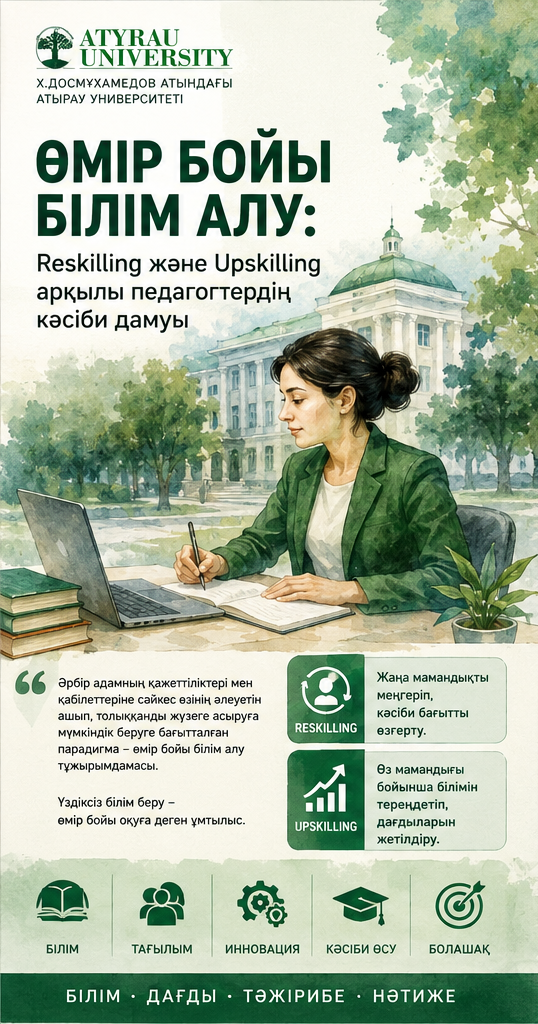
The concept of lifelong learning is a paradigm aimed at enabling every individual to unlock and fully realize their potential according to their needs and abilities. Continuous education reflects a commitment to learning throughout one’s life. In today’s labor market, the rapid advancement of technology and evolving professional requirements demand that individuals continuously update their knowledge and skills. In this context, the concepts of reskilling and upskilling have become increasingly important, helping professionals remain competitive in their careers.
The organization of professional development and teacher retraining courses that support lifelong professional growth, the search for and implementation of effective forms and methods of retraining and advanced training, as well as the provision of long-term and short-term courses based on innovative technologies for faculty members seeking to enhance their professional qualifications, are among the key responsibilities of the Office for Staff Retraining and Professional Development.
Since the 2020-2021 academic year, Kh. Dosmukhamedov Atyrau University has been offering Teacher Retraining Courses for individuals who do not possess a pedagogical degree but have professional qualifications in a relevant field and have chosen teaching as a new career path. During the program, participants complete two semesters of study and undertake teaching practice in schools. At the end of the academic year, they take final certification examinations to demonstrate the knowledge and professional competencies acquired throughout their studies and teaching practice. Those who successfully pass the examinations receive certificates confirming their qualifications and competencies.
The teacher retraining courses were conducted according to the planned curriculum of 45 credits during the 2022-2023 and 2023-2024 academic years. Beginning with the 2024-2025 academic year, the program has been expanded to 63 credits under new educational programs. In the 2025-2026 academic year, 82 participants completed the program, successfully passed their final assessments, and will receive their certificates in June. Through this process, they acquire a new profession, which represents the essence of reskilling.
As part of the upskilling initiative, Kh. Dosmukhamedov Atyrau University successfully completed two professional development courses designed to enhance educators’ competencies in line with modern educational requirements:
* “Applying IT and AI in the Educational Process” (72 hours)
* “Integration of Cloud Computing, IoT, and Robotics” (80 hours)
Since the beginning of the academic year, four cohorts of the 72-hour course “Applying IT and AI in the Educational Process” have been organized for university faculty members, with more than 100 instructors improving their qualifications. The course aims to enhance educators’ information, communication, and digital competencies and to teach the effective use of modern IT tools and artificial intelligence technologies in education.
The course was developed by G.A. Saltanova, Candidate of Physical and Mathematical Sciences and Associate Professor. It was delivered by senior lecturers of the Department of Informatics, E.G. Gaisina and A.I. Kumargaliyeva.
During the course, participants learned to work with popular digital platforms such as Canva, Quizizz, Wordwall, LearningApps, Genially, Padlet, Google Jamboard, Miro, and Stepik; create electronic portfolios; design interactive assignments and feedback tools; and develop educational video lessons.
In addition, an 80-hour professional development course entitled “Integration of Cloud Computing, IoT, and Robotics” was organized for teachers in the Atyrau Region. The course content, approved by the University Academic Council and coordinated with the Office for Staff Retraining and Professional Development, was designed for science teachers interested in informatics and STEM education. Its objectives included enhancing professional competencies, integrating modern technological achievements into teaching practices, and guiding educators in developing engineering and STEM-based research and creative projects together with students.
The course included the following modules:
* Developing robotics projects using the Arduino platform;
* Fundamentals of IoT technology and its connection with robotics;
* Introduction to cloud computing;
* Integration of cloud computing and IoT technologies, including programming in the Arduino IoT Cloud environment.
The course organizers and trainers were Meiramgul Mukhambetova, PhD and Associate Professor of the Department of Informatics, and Nurgul Baitemirova, Senior Lecturer and Master’s degree holder from the Department of Software Engineering.
Alongside face-to-face practical sessions, participants were supported through a digital portal developed by the organizers within the framework of the “Young Scientist” project. At the conclusion of the course, teachers presented projects demonstrating the integration of newly acquired knowledge into the educational process, including collaborative student research projects and elective course plans.
From December 17 to 19, 2025, a 36-hour short-term professional development course entitled “Practical Application of ISO 37001 International Standards in Anti-Corruption Activities” was organized for employees of the Atyrau Region Department of Economic Investigations.
The course aimed to foster an anti-corruption culture, familiarize participants with the structure and practical implementation of the ISO 37001 international standard, and develop skills in conducting internal investigations and anti-corruption reviews of contracts.
During the training, participants studied:
* The fundamental principles of ISO 37001;
* Corruption risk management mechanisms;
* Internal control and prevention measures;
* Practical approaches and tactics for internal investigations.
The course trainer was Zhanna Shayakhmetova, Candidate of Legal Sciences, Associate Professor, and Associate Professor of Law. Upon completion, participants received certificates confirming their professional qualifications.
From April 7 to 23, 2026, an 80-hour professional development course entitled “Developing Professional Competencies in Teaching Solfeggio and Music Theory” was organized for performing arts professionals.
The course aimed to improve participants’ theoretical musical knowledge, introduce modern approaches to teaching solfeggio and music theory, and strengthen their pedagogical competencies.
The author and trainer of the course was Bakyt Turmagambetova, Acting Associate Professor of the Department of Music and Arts and Candidate of Art Studies.
Twenty participants, including teachers and performing arts specialists from children’s music schools, arts schools, and creative institutions of the West Kazakhstan Region, attended the course.
Throughout the program, participants mastered:
* The core areas of solfeggio instruction;
* Key topics in music theory;
* Methods for developing musical hearing;
* Techniques for conducting intonation exercises and musical dictations;
* Practical applications of modern educational technologies and innovative teaching methods.
At the end of the course, participants defended creative projects and received certificates confirming the successful completion of the professional development program.
In modern society, the concept of lifelong learning has become a vital mechanism for both professional and personal development. The rapid pace of technological advancement and changes in the labor market require specialists to continuously acquire new knowledge and skills. In this regard, reskilling and upskilling have become essential tools for maintaining and enhancing professional competitiveness.
These courses make a significant contribution to improving the quality of education, developing the professional potential of educators, and fostering innovative growth in the regional education sector.
Upskilling refers to the process of deepening knowledge and improving professional skills within one’s existing profession.