University’s Partnership in Sustainable Development Highly Recognized at the National Level
For Khalel Dosmukhamedov Atyrau University, expanding partnerships in the field of sustainable development is one of the key strategic priorities.
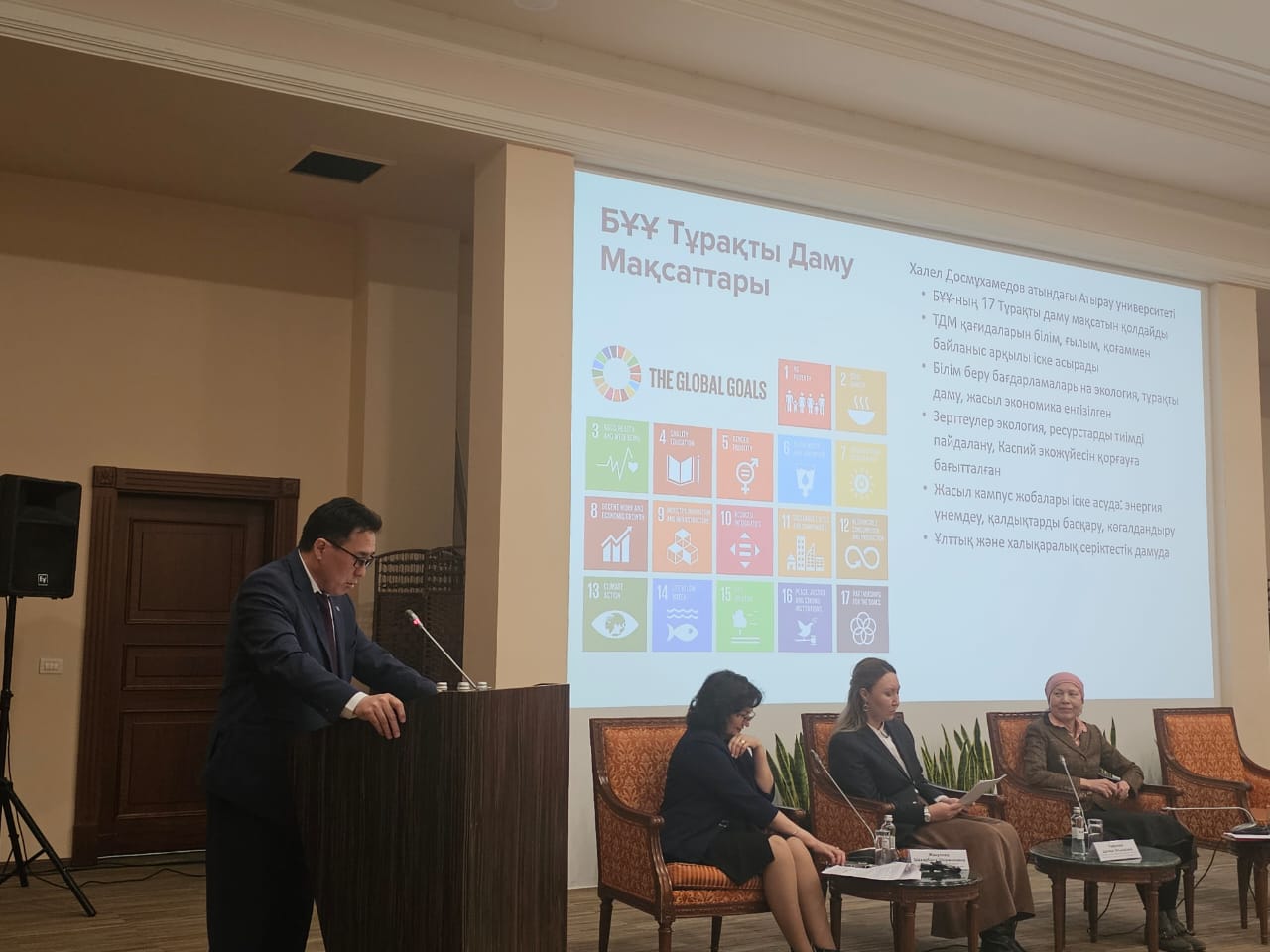
Recently, the university received a letter of appreciation from the Economic Research Institute under the Ministry of National Economy of the Republic of Kazakhstan. The letter highly praised the active participation of university representatives in the roundtable titled “The Contribution of Higher Education Institutions to the Implementation of the Sustainable Development Goals,” held on April 10, 2026 in Astana.
During the event, the Vice-Rector for Strategic Development and Internationalization, Doctor of Education Management, Candidate of Legal Sciences, Associate Professor Bakhyt Omirkhanuly Altynbassov delivered a presentation on the impact of scientific research conducted by faculty members and students on the sustainable development of the region, as well as their role in addressing social and environmental challenges.
In addition, the Dean of the Faculty of Natural Sciences, Candidate of Technical Sciences, Associate Professor Mansiya Sanakkizi Yesenamanova shared the university’s experience in training specialists in ecology and sustainable development, implementing educational programs, and supporting student research initiatives aimed at addressing pressing environmental issues in the region.
Such cooperation is highly beneficial for the university. Firstly, it allows the institution to demonstrate its expert potential at the national level. Secondly, participation in discussions on sustainable development strengthens the link between science, education, and regional development. Thirdly, such platforms contribute to the development of new partnership models in higher education that respond to the needs of the state, business, and society.
During the discussion, Dr. B. Altynbassov emphasized that cooperation between universities and industry is beneficial for both sides. For universities, such interaction helps adapt educational programs to labor market demands, develop students’ practical skills, strengthen applied research, and enhance graduates’ competitiveness. For industry, it provides access to new ideas and scientific solutions, effective proposals for solving sectoral challenges, and opportunities to train qualified specialists.
This direction is particularly important for the Atyrau region, where issues of ecology, efficient use of natural resources, green technologies, workforce training, and social responsibility are closely interconnected.
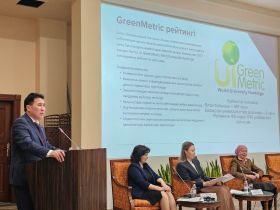
The issues raised in the presentation attracted significant interest from the institute and ministry representatives. This demonstrates that regional universities can make a real contribution to the sustainable development agenda and that university–industry collaboration remains a relevant topic at the national level.
Participants of the meeting agreed to submit their proposals to the ministry in the near future regarding sustainable development and strengthening cooperation between universities and industry. Currently, an analytical report is being prepared that will include proposals aimed at enhancing the contribution of regional universities to sustainable development, deepening the connection between science and industry, and effectively utilizing the expert and innovative potential of universities.
For the university, such partnerships are not only a platform for exchanging experience but also an important direction that contributes to the strategic development of the university, the solution of regional challenges, and the sustainable future of the country.